

Bottom line: Ipe can suit an Ontario homeowner who wants real wood, accepts colour change or periodic refinishing, and is prepared to verify sourcing and hire for hardwood-specific installation. It is a weaker fit when the priorities are the simplest installation, a highly predictable board-to-board appearance, or a long manufacturer-backed system warranty. Still weighing options? Compare families in our decking materials hub, or read wood against composite over ten years if the real question is whether the deck should be wood at all.
What is Ipe?
Ipe (pronounced “ee-pay”) is a timber trade name, not one single tree species and not simply another name for walnut. Current CITES guidance applies the name to timber from species in the Handroanthus, Tabebuia, and Roseodendron genera. These trees occur across parts of the Americas; Brazil is the largest exporter, but the wood does not grow only in Brazil.
The USDA Forest Products Laboratory describes Ipe as very heavy wood with fine-to-medium texture and straight to irregular, often interlocked grain. Its reference material reports an average density of about 1,025 kg/m³ at 12% moisture content, hardness two to three times that of white oak, and strong natural resistance to decay and insects. Those properties explain its use for demanding exterior work, but they do not make every board knot-free, maintenance-free, or immune to movement.
Avoid treating “Class A,” “non-slip,” or a fixed 75–100-year lifespan as universal Ipe specifications. Fire, slip, warranty, and service-life statements need documentation for the exact product, finish, installation, and test method being proposed.
Is Ipe a good fit for an Ontario deck?
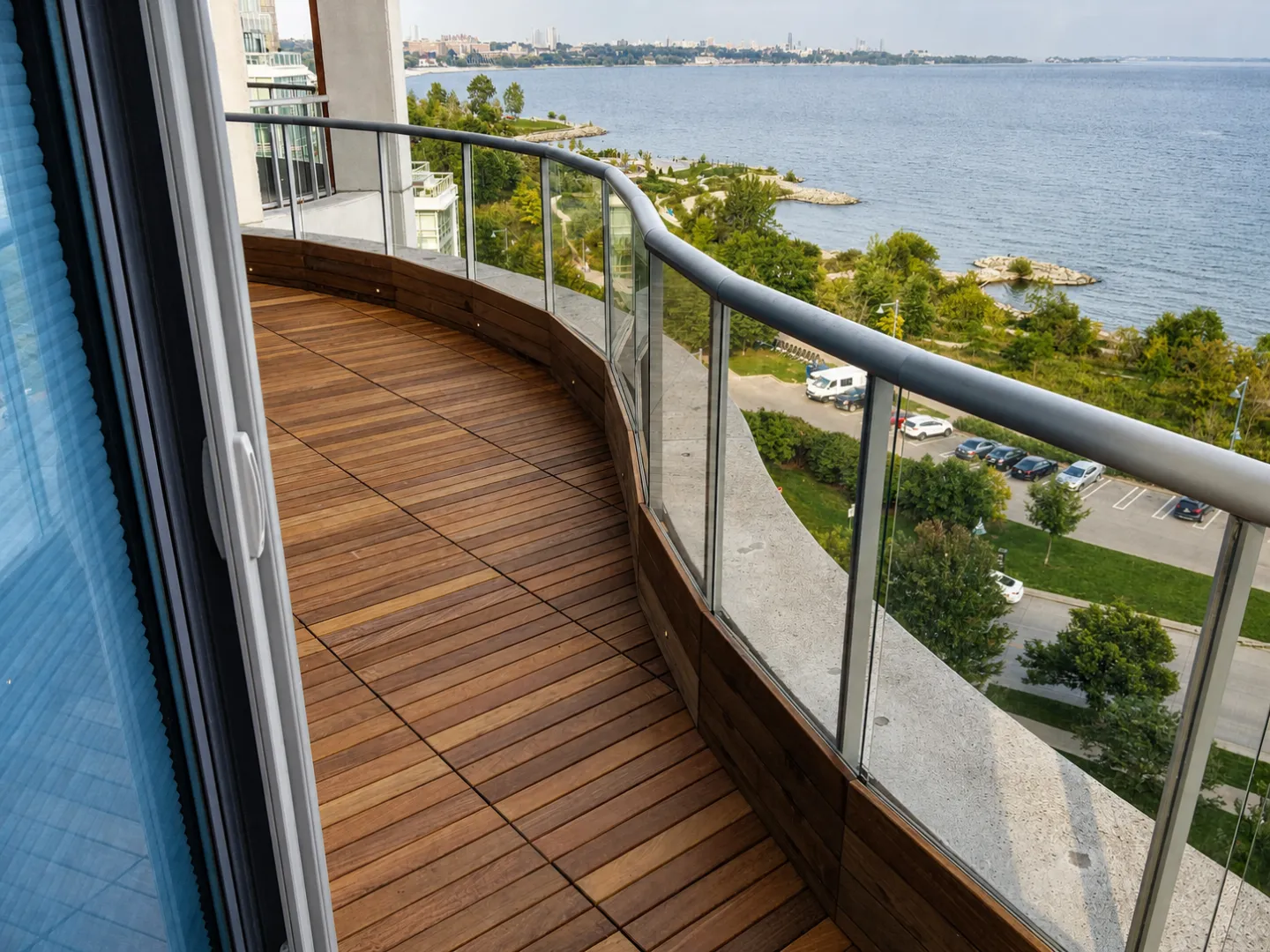
Ipe’s density and natural decay resistance are useful exterior-deck qualities. Ontario performance, however, still depends on controlling water and allowing the wood to adjust to site conditions. A good design provides drainage between boards, airflow below the deck, sound flashing and framing, and no pocket where meltwater or rain can sit.
Reasons homeowners choose it
- Real-wood appearance: colour and grain vary naturally rather than repeating a manufactured pattern.
- Dense wearing surface: the wood is hard and suited to demanding exterior use.
- Natural durability: the heartwood has strong resistance to decay and insect attack.
- Two valid colour paths: use a compatible penetrating finish to retain more brown colour, or allow the surface to weather toward silver-grey.
Trade-offs to budget for
- More installation labour: dense boards are heavy, difficult to machine, and normally require sharp carbide tooling, pre-drilling, and hardwood-compatible fasteners.
- Variable material: colour, grain, moisture condition, profile, and lengths can vary by shipment. Approve representative boards, not one small sample.
- Appearance maintenance: keeping a rich brown tone requires periodic cleaning and refinishing; the interval depends on exposure and the finish system.
- Sourcing due diligence: Ipe-traded genera are now controlled under CITES Appendix II, making origin and supply-chain documentation an important buying question.
What Ipe costs today
Live Composite Deck Shop prices for Ipe boards by size and length, next to two premium composite lines for scale. Imported hardwood moves with grade, freight and exchange rates, so these numbers change more often than composite.
For comparison: the composite lines that sit in the same price band as Ipe.
Composite Deck Shop prices as of Sep 29, 2026 · CAD, before tax and delivery
Board prices only, per board as sold. Board-only prices are not equivalent project prices: compare boards, waste, framing, fasteners, trim, finish, labour and tax as one system.
The fixed prices and seasonal “best month to buy” claims from the old DecksToronto article have been removed in favour of the live prices above. Ask every bidder to identify the same scope:
- board dimensions, profile, grade, moisture condition, and available length mix;
- waste allowance and any charge for length sorting;
- stainless fasteners or hidden-fastener system, starter boards, plugs, and end-grain sealer;
- initial finish, future refinishing expectations, and whether all sides need treatment for the proposed assembly;
- substructure, joist protection, stairs, fascia, guards, delivery, installation, permits, and HST;
- written product and workmanship warranties, including exclusions.
Ipe vs composite decking
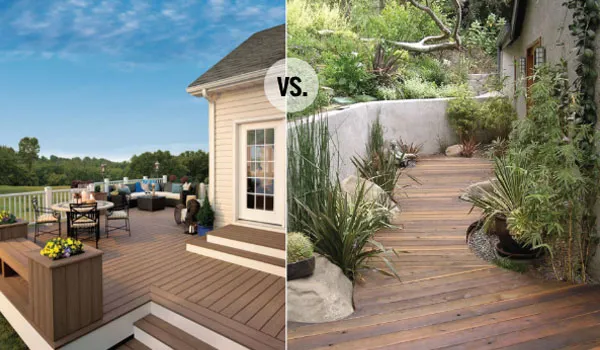
Compare Ipe with the exact capped-composite product you are considering, not with an industry-wide average. Composite recipes, warranties, installation rules, surface temperatures, and slip results vary by manufacturer and collection. For a worked brand-versus-brand example, see our Fiberon vs Trex comparison.
| Decision point | Ipe | Capped composite |
|---|---|---|
| Look | Natural variation in real wood; browns weather toward grey. | More predictable colour and pattern; compare full boards for repetition. |
| Routine care | Clean as needed; refinish when you want to preserve or restore brown colour. | Usually cleaned without refinishing; follow the exact manufacturer’s care guide. |
| Installation | Hardwood experience, pre-drilling, moisture planning, and compatible stainless fasteners are important. | Must follow the brand’s span, gapping, fastening, and temperature rules. |
| Buying proof | Ask for species/origin, CITES traceability, grade, moisture condition, and any FSC claim. | Ask for the current installation guide, warranty, evaluation reports where applicable, and approved fasteners. |
| Warranty | Varies by seller or branded product; natural durability is not itself a written warranty. | Often comes with a manufacturer warranty, subject to exclusions and installation compliance. |
| Cost comparison | Board prices sit with premium composite (see the price section); installation labour is usually higher. Compare delivered and installed systems, not boards. | |
Do not assume either surface will always stay cooler or provide better traction. Colour, sun exposure, finish, moisture, texture, and the specific product all matter. Test current samples where these are priority concerns.
Responsible sourcing: what to ask for
International trade in Ipe is controlled, not banned. The CITES Appendix II listing for the Ipe-traded genera took effect on November 25, 2024. Appendix II trade generally relies on export documentation from the country of export; Canadian permit requirements depend on the appendix, item, and movement. A homeowner buying domestic stock is not in the same position as an importer, but the seller should still be able to explain the material’s traceability.
- Ask for the scientific genus or species and country of harvest. “Brazilian walnut” or “ironwood” alone is not precise identification.
- Ask how post-listing imports were documented. The supplier should be able to confirm that the shipment moved under the applicable CITES controls.
- Verify any FSC claim. Ask for the FSC claim on the sales document and the supplier’s licence or certificate code, then check it in FSC Search. A general claim that a company “can supply FSC” does not prove that your boards are FSC-certified.
- Keep the paperwork. Save the quote, invoice, product description, warranty, and installation guide with your project records.

Installation and fastening
Do not use the old 24-inch-on-centre claim as a framing instruction. Joist size and spacing are structural design decisions. Deck-board span data is not a substitute for an Ontario-compliant deck design, the approved permit drawings, or the exact supplier’s installation requirements.

- Confirm the material before framing. Board thickness, profile, moisture condition, and fastening system affect details and spacing.
- Acclimate and store correctly. Follow the supplier’s written instructions; keep boards supported, dry, shaded where required, and ventilated rather than directly on soil or concrete.
- Plan drainage and cross-ventilation. Do not trap standing water below the deck or close the perimeter in a way that blocks needed airflow.
- Use the specified gaps. Required spacing depends on whether material is air-dried or kiln-dried, its width and moisture content, and the fastening system. One gap is not correct for every shipment.
- Cut clean and seal the ends. Use sharp, high-tooth-count carbide blades and seal fresh end cuts with the specified end-grain product. Fastening has its own rules, covered below.
- Control wood dust. The Canadian Centre for Occupational Health and Safety recommends source extraction, HEPA-filtered cleanup, suitable protective equipment, and methods that do not blow dust back into the air.
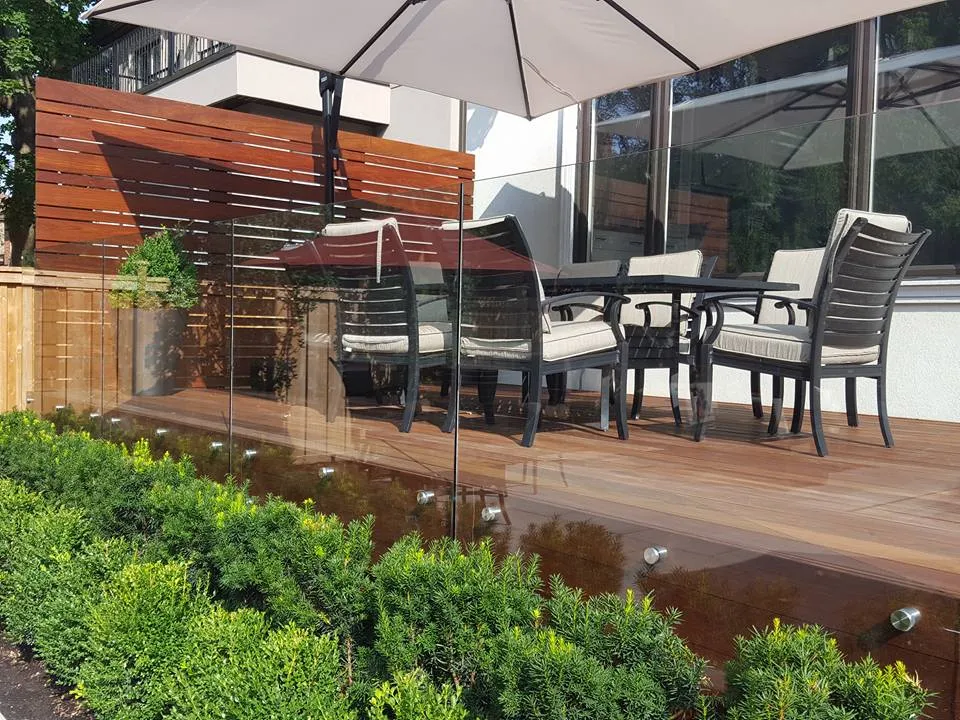
An installer should be able to show previous tropical-hardwood work and explain moisture measurement, ventilation, board sorting, end treatment, fastener selection, and how butt joints will be supported. “We install all decking the same way” is not a reassuring answer. If you would rather hire out the build, see our deck building services.
How Ipe is fastened
On a board this dense the fastener is a material decision, not a hardware detail — it sets the gap between boards, decides whether the surface shows anything at all, and is the one part of the job where the wrong metal damages the deck by itself.

Stainless, or the deck stains itself. The Forest Products Laboratory describes iron stain as a reaction between the extractives in the wood and the iron in steel fasteners, which shows up “the first morning after rain or dew” once water lets the two meet. Its recommendation is the one to follow — stainless steel, whose corrosion rate in FPL testing was statistically indistinguishable from zero. Plain steel can leave black stains around the fixings.
The clip you buy encodes how dry your boards are. DeckWise publishes two versions of the same Ipe Clip. The Extreme “automatically spaces deck boards at 3/32" (2,4mm)” and is described as allowing for the expansion of air-dried hardwood; the ExtremeKD spaces them at “1/4" (6,4mm)” and is for kiln-dried stock. That is the same air-dried-versus-kiln-dried question from the installation checklist above, answered in hardware: boards that still have shrinking to do go down tight, boards that do not go down at close to their final gap. Both take a #8 × 2 in. stainless star-drive screw, both need a slot 1/2 in. deep and 5/32 in. wide cut into the board edge, and both drive that screw at 45° so the board can still move across its width.
Where a clip cannot go, the screw is hidden instead. Borders, stair treads, fascia and repairs are face-fastened: pre-drill, counterbore, drive a stainless screw, and cover the head with a 3/8 in. tapered plug cut from the same species. Pre-drilling is not a refinement — DeckWise ships a 1/8 in. bit in its kits for exactly this. Ipe is never nailed.
Composite Deck Shop stocks the DeckWise Ipe Extreme clip at the 3/32 in. spacing, along with stainless screws and bits: see the current deck fasteners collection. The plug diameter, the clip version and the screw length all have to match the boards you are actually supplied, so settle the fastening system in the same conversation as the material — not after it arrives.
Care, cleaning, and colour
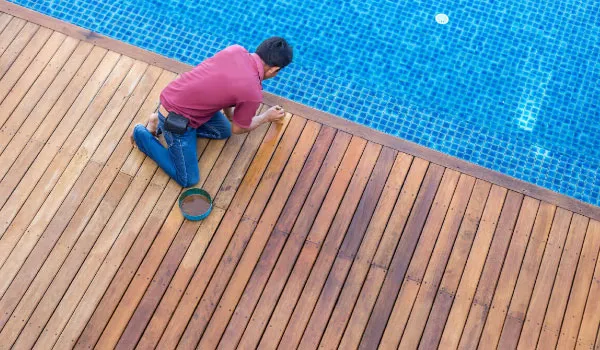
Oiling is primarily a colour decision, not proof of a guaranteed lifespan. If you prefer brown, use a penetrating finish specifically approved for dense tropical hardwood and reapply according to its instructions and your deck’s exposure. If you prefer silver-grey, allow the surface to weather evenly while still keeping it clean and well drained. Our deck oils and stains guide covers the products, the conditions Ontario allows, and safe handling of rags and leftovers.
- Sweep away leaves and debris that hold moisture.
- Clean with methods approved by the finish and wood supplier; test in an inconspicuous area first.
- Inspect fasteners, checks, splinters, drainage, flashing, stairs, and guards at least seasonally and after damage.
- Before sanding or refinishing, control dust and follow the coating manufacturer’s preparation instructions.
No source checked for this review supports promising every Ipe deck a fixed 50-, 75-, or 100-year life. Service life depends on the supplied wood, design, exposure, workmanship, and maintenance. Use a written warranty—if one is offered—to understand what is actually covered.
Permits and project planning in Ontario
The decking species does not change whether the structure must comply with the Ontario Building Code, zoning, guards, stairs, footings, or permit requirements. The City of Toronto says some detached decks may not need a permit, while its deck and porch process requires scaled, dimensioned drawings and details for footings, beams, stairs, and guards when a permit is required. Toronto applications are currently submitted online.
Confirm requirements with your municipality before ordering material, especially when the project changes deck size or height, attaches to the house, adds stairs or guards, approaches property lines, affects trees, or sits over occupied space. Our Toronto deck permits guide walks through the consolidated Ontario and Toronto process, and Toronto homeowners can also start with the City’s current decks and porches guide.
Useful sources
Product availability and municipal processes can change, so follow the linked current documents when you are ready to buy or apply.
- USDA Forest Products Laboratory — characteristics of commercially important woods: Ipe range, density, grain, hardness, durability, and uses.
- USDA Forest Products Laboratory — bondability of Ipe wood: high density, interlocked grain, wet-condition movement, exterior durability, and adhesive limitations.
- CITES Secretariat — guide to CITES-listed tree species and 2024 implementation notification: genera traded as Ipe and the Appendix II effective date.
- Environment and Climate Change Canada — permits for trade in protected species: Canadian CITES permit and border-validation guidance.
- Forest Stewardship Council — claims check: how to verify FSC product and supplier claims.
- DeckWise — hardwood decking installation guidance: storage, acclimation, gaps, ventilation, pre-drilling, stainless fasteners, end sealing, and finishing.
- DeckWise — Ipe Clip Extreme and Ipe Clip ExtremeKD: the 3/32 in. and 1/4 in. board spacings, the 1/2 in. × 5/32 in. edge slot, the #8 × 2 in. stainless screw, and the drill bit supplied with each kit.
- USDA Forest Products Laboratory — iron stain on wood: why steel fasteners mark tannin-rich wood, when the stain appears, and which metals avoid it.
- Canadian Centre for Occupational Health and Safety — wood dust: health risks and exposure controls.
- City of Toronto — decks and porches: current permit, drawing, and online-application guidance.